
Suhozid.hr
What is Suhozid.hr?
Suhozid.hr is a webGIS database of Croatian dry stone heritage where dry stone sites can be publicly entered and viewed with the help of an interactive web map. It was designed and managed by activists from the Croatian dry stone wall and geoinformation scene, and during its ten-year work it was supported by the HAZU Foundation, the Ministry of Culture and Media, the company GIS Cloud, the Donors’ Initiative For Mediterranean Freshwater Ecosystems through Still Water Revival project and several individual volunteers who contributed to its form and content, either through their knowledge of dry stone wall buildings or through IT knowledge.
What’s new on Suhozid.hr since April 2023?
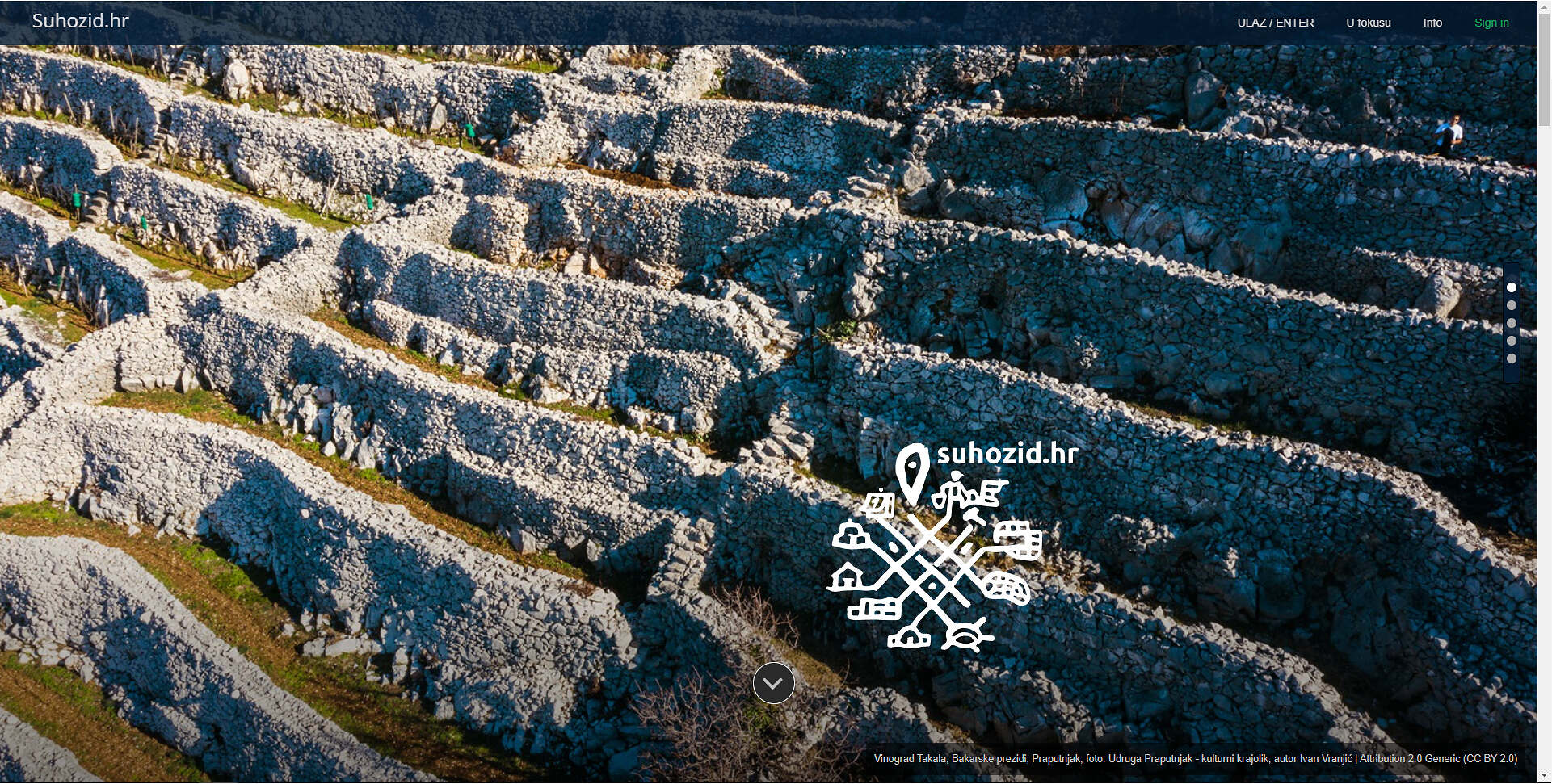
Old visitors of Suhozid.hr will immediately notice a new logo and a new cover, from which an interactive map is entered by clicking on ENTER (or by clicking on the logo). By scrolling down, there are links to some separate content units, instructions for use and impressum.
Substantively, the biggest novelty is two new thematic groups, i.e. two new layers that have joined the previous layer of Suhozidi (Dry stone objects): These are People and communities and Activities. In this way, Suhozid.hr joins current trends in the preservation of cultural heritage, where the focus is no longer only on objects, but also on the communities of their creators (and scholars) and on their activities. This is especially important in dry stone heritage, which is located at the intersection between the material and the immaterial (do we even need to mention UNESCO anymore?) Thus, in the People and Communities layer, all those builders and their organizations were found for the beginning, about which we collected data when creating the list of bearers of cultural goods (in Croatian) this time also from the locations on the map.

Another novelty is the expansion of data content within layers, so in addition to names and descriptions, more detailed data can be found, or at least the space in which they can be entered. Fine search options are quite large in the new interface, and with data filling it will be possible to extract and present more of them.
You will certainly also notice the new cartographic interface. This is Arches, an open source webGIS solution developed by the Getty Institute and the World Monument Fund specifically for cultural heritage mapping projects. On the homepage, we have provided some basic instructions, but we believe that you will quickly discover new opportunities yourself. On the left side of the map there is a list of entries, which can be filtered using several options. Let’s just mention the most useful ones: The Search window on the top left is the most basic search engine known to everyone, Advanced up in the middle offers a lot of search options by various criteria, Overlays on the right offers the ability to ignite and turn off the layers displayed on the map, and Legend the order of their display (which goes above which). Clicking on the colorful dots on the map opens the pop-ups of individual entries, which are turned into individual pages dedicated to a particular entry by clicking on PHOTO+INFO.

Unfortunately, and as powerful as it is, Arches still has bolks, so it is quite useless on the mobile screen because it can not be clicked on the dots on the map, and in the middle of this entire migration of Suhozid.hr to the new platform, support for the mobile crowdsourcing application has been stopped, so we will obviously have to be patient while the developer community solves these problems.
How can I join?
Of course, as before, you can contribute to Suhozid.hr by sending data on dry stones and/or their builders.
In addition to photography and the exact location, various data are also welcome, especially local names, dimensions or sketches, data on builders and origins, as well as former and current users.
It does not matter if something has already been included in the list: sometimes a new photo or data can reveal a hitherto unknown and valuable fact about our space and its builders.
- By sending data by e-mail to popis@suhozid.hr
- By logging in and uploading data through the web interface according to the instructions we have put here (in Croatian).
Collaborators with over 25 successful web entries can get Editor status and access to all layers! In addition, we invite all interested parties to come forward if they want to volunteer to supplement existing and create new entries.
… and we hope that the mobile crowdsourcing app will soon work…….